


Yes, I Use AI. No, AI Doesn’t Do My Work.
What it means to be a creative in the age of artificial intelligence
Something happened recently that made me realise just how misunderstood creative work is becoming in the age of AI. A client and I were speaking about a presentation I had created for her brand. It had taken me roughly five hours to put together — thinking through the direction, building the layouts, choosing typography, working with colour, refining the flow, creating imagery where it was needed, and eventually assembling the entire presentation in InDesign. She thought it had taken me about twenty minutes. She thought the presentation was basically a prompt. And I remember thinking: Wait. What?
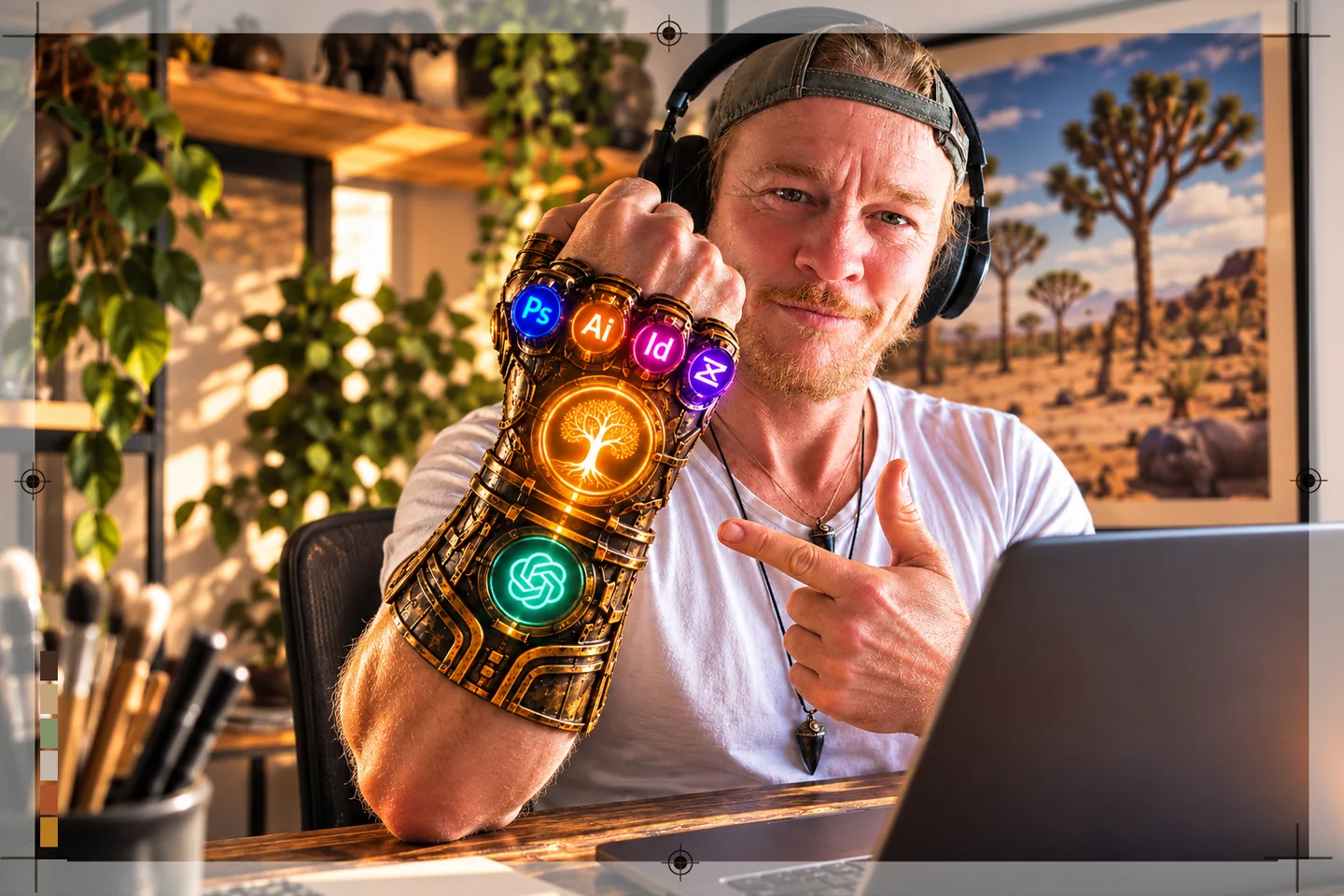
Yes, I had used AI to create some of the imagery. But AI had not created the presentation. I had. The same thing has started happening with my own work. When I launched the new visual direction for my business, people saw the finished artwork — photography, crop marks, registration marks, colour bars, overlays, texture, typography and all the little graphic details surrounding it. And because AI is now part of my process, there is sometimes an assumption that the entire thing was simply generated.
But those crop marks didn’t magically appear. I built them. That circle with the cross through it? I made it. The colour bars were individually created and positioned. The photographs were mine. The layers were built in Photoshop. Colours were blended over images. Typography was considered. Things were moved, removed, adjusted, rejected, rebuilt and refined. AI was involved, but AI was not sitting at my desk doing my work.
I think this is going to be one of the strangest parts of being a creative during this particular moment in history.
When the tool becomes visible, the work becomes invisible
For years, people looked at a finished design and automatically understood that someone had made it. They might not have known exactly what went into it, but there was an assumption of labour behind the result. Someone chose the photograph, someone decided on the typeface, someone created the composition, someone adjusted the colours, and someone sat there moving things around until they finally felt right.
Now, increasingly, people see something polished and immediately think: AI. And suddenly hours of decision-making can disappear behind one word. Perhaps that is partly because generative AI is so impressive. We are now able to create images that would have been extremely expensive, difficult or sometimes impossible to produce only a few years ago. If I need a very specific visual for a concept, I can describe it and begin exploring. That is incredible.
But there is a huge difference between generating an image and creating a finished piece of communication. There is also a difference between having access to a tool and knowing what to do with it.
Yes, I use AI. No, AI doesn’t do my work.
I use AI every day. I’m not embarrassed about that. In fact, I find it incredibly exciting. I use it for experimentation, visualisation, ideation, imagery, research, problem-solving and sometimes simply to play, but it is one tool inside a much larger creative process.
There is still Photoshop. There is still Illustrator. There is still InDesign. There is still photography, typography, composition, brand strategy, storytelling, editing and art direction. And perhaps most importantly, there is still judgement. AI can give me an image, but it cannot automatically tell me whether that image belongs in the brand. It can generate twenty options, but someone still has to know which option is right — or that none of them are right.
Someone needs to understand the audience, the brand, the tone, the message and the emotion behind what we are creating. That is where the work happens.
The uncomfortable question of ownership
AI has also forced me to think differently about creativity itself. Artists are protective over their work. I certainly am. We invest ourselves in the things we create, so naturally there is pride and ownership attached to them. But this technology has also made me question what we mean when we say something is completely “ours.”
None of us creates in isolation. Artists learn from other artists. Designers learn from other designers. We absorb films, books, music, architecture, photography, advertising and culture. We learn from the people who taught us, from childhood and from nature — from the colours of the desert, from the ocean, from the shape of a tree, from light falling through a window. We take all of that in and eventually something new comes back out through us.
So where exactly does influence end and creation begin?
That is not an argument that removes the ethical questions surrounding AI. Those questions are real. But it does make the subject of authorship far more complicated than simply saying human equals original and AI equals copied. Creativity has always been an enormous conversation between everything that came before us and everything we are creating now. AI has simply made that conversation impossible to ignore.
And yes, the ethics matter
I don’t think embracing AI means pretending that every criticism of it is ridiculous. Copyright matters. Consent matters. Transparency matters. The livelihoods of artists, photographers, writers and other creatives matter. Passing something off as something it isn’t matters. There are questions about how models are trained, what happens to creative industries, how jobs change, where disclosure becomes necessary and how we establish new boundaries around authenticity. We should be having those conversations.
But I also don’t believe fear should be the only thing guiding them. There is a difference between questioning a technology and refusing to understand it. And I think some of the fear around AI comes from simply not knowing what it is capable of, how it works, or what working with it actually feels like.
Sometimes fear disappears the moment we start playing
This weekend I was spending time with my partner’s father and started showing him what could be done. It began very simply: imagine something, ask for it, generate it. Then I started doing what I naturally do when developing an image. Okay, but what exactly do you like about this? What feeling are we trying to create? Where are you standing when you’re looking at the scene? What angle are we seeing it from? What should be closer? What should be further away? What happens if the light changes? What happens if we make it quieter?
Suddenly it wasn’t this frightening machine replacing artists. It was play. They were imagining things and then watching those ideas begin to appear in front of them, and they had fun. A lot of fun. That’s the part of AI that I think many people are missing because they’ve already decided they need to be afraid of it.
Once you stop treating it as some mysterious thing happening somewhere outside of you and actually begin experimenting with it, you quickly discover that the most interesting part isn’t necessarily what AI can imagine. It’s what you can imagine now that you have another way of exploring it.
The most beautiful thing about AI, to me, is when it becomes an instrument — something that helps us question more deeply, recognise patterns, become more curious, and ultimately listen more closely to ourselves.
We are in a transition
I also think we need to accept that there is going to be confusion for a while. The language hasn’t caught up with the technology yet. At the moment, somebody who types one sentence into a generator and publishes the first thing that appears can be placed into the same category as a designer who spends hours directing, generating, compositing, illustrating, photographing, retouching and building a final artwork. Both get called “AI.” Those aren’t the same process.
Over time, I think we will become better at recognising the differences — AI-assisted design, generative art, creative direction using generative tools, AI illustration, traditional illustration, hybrid workflows. Whatever language eventually develops, we are clearly moving into a world where the tool itself will no longer tell us very much about the amount of thought behind the final product. And maybe that is okay.
Photography did not destroy painting. Photoshop did not destroy photography. Digital design did not destroy drawing. Every generation of creatives eventually inherits new tools. Some people embrace them, some reject them, some misuse them, and some do extraordinary things with them. Eventually, the novelty disappears and we’re left with the work.
I don’t need to prove myself every time
This is probably the biggest thing I am personally learning. I cannot spend the next ten years explaining every piece of work I make. I cannot keep opening Photoshop and showing every layer because someone assumes I pressed a button, and I cannot constantly defend my creativity because my tools have changed. That would be exhausting.
There will be people who have ethical objections to AI, and there will be people who simply do not want to work with someone who uses it. That is their choice, and that is okay. I am probably not the designer for them, because I am not moving backwards. I am interested in where this goes and in what becomes possible when twenty years of design experience meets technology that allows me to create in entirely new ways.
I’m also interested in helping other people understand how to use those tools without losing the thing that actually makes their work theirs: their voice, their intention and their identity.
So what is my role now?
This may be the most important question AI has forced me to ask. For a long time, I described myself as a graphic designer, but increasingly that description feels too small for what I actually do.
My value was never really that I knew how to press the right buttons in Photoshop. It wasn’t that I could draw a circle in Illustrator or place a photograph inside a frame in InDesign. Those were simply tools I learned in order to execute ideas. My role is to see the bigger picture — to understand what a brand is trying to become, to find the story inside it, to decide what it should feel like, to build visual languages around that feeling, to connect ideas, to recognise what works and what doesn’t, to direct, to position, and to create systems that allow businesses to communicate consistently.
And now, increasingly, my role is also to help people understand how AI can become part of that system without allowing it to replace their identity. That is why my work is shifting more towards art direction, brand positioning and AI training systems.
The tools beneath that work will continue changing. They always have. I have no idea what software I’ll be using ten years from now. Maybe we won’t even have screens. But I suspect my responsibility will still be exactly the same: to decide what we are trying to say, to understand why we are saying it, and to find the most meaningful way to bring it to life.
So yes, I use AI. And no, AI doesn’t do my work. It is simply one more tool I have learned to work with.
The tools have changed. The responsibility hasn’t.
~ If you’re curious about how AI can support your brand without replacing its voice, get in touch with me about my Brand-Aligned AI System™. I help businesses align AI with their identity, values and way of communicating... so the technology supports the brand, rather than becoming the brand.