



Earth Is Our Playground. Creativity Is Our Gift.
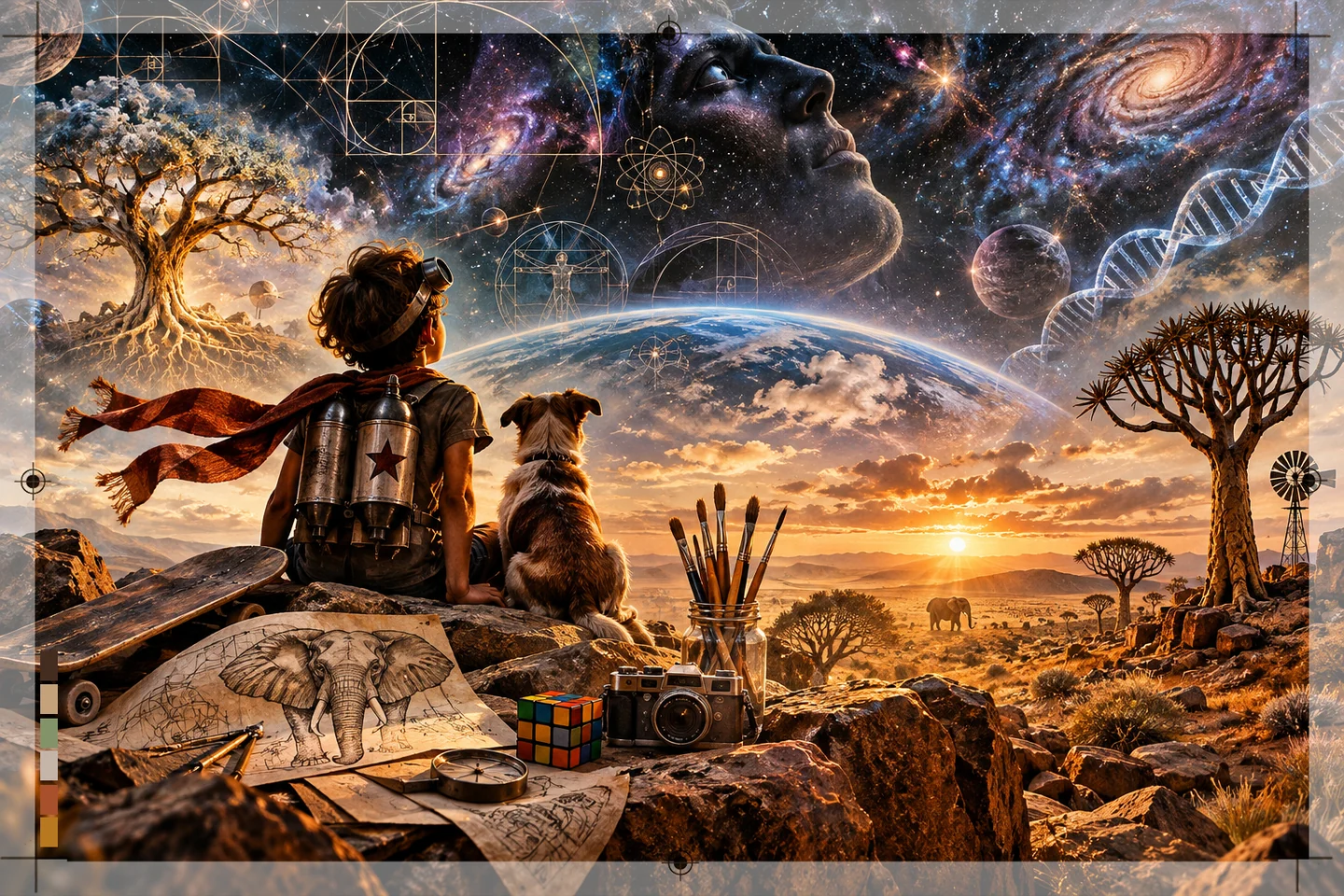
I was thinking the other day about generations and where exactly I fit into them. I was born in 1985, which apparently makes me a Millennial, although I've always felt more connected to the generation before mine. I suppose part of that comes from growing up in a world that was still wonderfully analogue. We didn't have smartphones, social media or an endless supply of entertainment waiting for us on a screen. We had our imaginations, the world around us and whatever we could find to entertain ourselves.
Growing up in Keetmanshoop, Namibia, the desert was our playground. A few rocks, some sticks, a patch of sand or an interesting tree could turn an ordinary afternoon into an adventure. We explored, invented stories, built things, imagined things and occasionally got ourselves into trouble. Looking back, I realise how much of my creativity developed during those years, long before I understood what being creative actually meant.
These days, we can spend hours consuming what other people have created, but I find myself increasingly fascinated by how our own imagination works. Everything we imagine seems to draw from something we've already experienced, observed or learned. Even the most fantastical ideas are built from familiar elements, rearranged and connected in different ways. A dragon, for example, combines characteristics we already recognise in nature. And that makes creativity even more fascinating to me. It's our ability to recognise connections, bring seemingly unrelated things together and discover new possibilities within what already exists. The more I think about it, the more I see those same connections in nature, mathematics, consciousness and the extraordinary experience of being human.
The extraordinary simplicity behind complexity
One of the things that fascinates me is how much complexity can emerge from relatively simple building blocks. Think about our number system. We use ten digits, from zero to nine, yet with those ten symbols we can express quantities so enormous they're almost impossible to comprehend. Mathematics allows us to describe relationships, recognise patterns and make sense of things that would otherwise seem completely chaotic.
Then there's DNA. Just four chemical bases, arranged in different sequences, encode the genetic information that helps shape an astonishing diversity of life. From the smallest organisms to the enormous variety of plants, animals and human beings, nature produces an almost unimaginable range of forms using a remarkably limited set of fundamental components.
Look at the branching of trees, the spiral of a shell, the structure of a flower or the patterns formed by rivers moving through a landscape. Mathematics appears throughout nature, in relationships we can describe precisely and in patterns we're still trying to understand. There's an extraordinary connection between simplicity and complexity, between structure and variation, and between the principles that govern the physical world and the possibilities those principles allow.
I find this fascinating because creativity works in a similar way. As designers, we work with a relatively small collection of fundamental elements: shape, colour, line, texture, space, typography and composition. Yet the possibilities for combining them are practically endless. Two people can begin with the same tools and materials and create something entirely different because they bring different experiences, observations, memories and intentions to the process.
We don't need an infinite number of ingredients to create something new. We need curiosity, imagination and the ability to recognise connections that weren't obvious before.
Nature, consciousness and the experience of creation
I've always felt a deep connection to nature, and for me that connection is also spiritual. I often think about the idea that nature is God's will in action. When I look at the natural world, I see this extraordinary process of creation unfolding continuously. Things grow, change, adapt, decay and become part of something else. Life expresses itself through countless forms, each existing in relationship to the world around it.
Science gives us remarkable ways to understand how these processes work, and I don't see spirituality and scientific curiosity as opposing one another. In fact, the more I learn about the natural world, the more extraordinary I find it. Understanding something doesn't automatically make it less magical. Knowing how a tree grows doesn't take away the wonder of standing beneath one.
I also think about what it means to be conscious of our own choices. Human beings have this remarkable ability to reflect on our actions, question our behaviour and consider the consequences of what we do. We can recognise when we've acted against our values, when we've caused harm or when something feels deeply out of alignment with who we are.
Even the concept of sin is something I interpret through that perspective. Rather than seeing it only as a list of forbidden actions, I see a connection to those moments when we act against our deeper truth, against what we recognise as good, compassionate or meaningful. That's my personal spiritual understanding, not a theological definition I'm trying to impose on anyone else.
And that brings me to another thought that has fascinated me for years: what if creation is how the Creator experiences itself?
What if consciousness, in all its different expressions, is part of something far greater than we currently understand? Imagine the extraordinary diversity of human experience, with billions of people seeing, feeling, learning and understanding the same universe in completely different ways. Each person experiences the world through their own memories, senses, relationships and perspective.
Two people can stand in front of the same tree and experience entirely different things. One sees its biological structure. Another notices the way sunlight moves through its leaves. Someone else remembers climbing a similar tree as a child, while an artist begins imagining a painting. It's the same tree, yet each person takes something different from the experience.
I've also had personal experiences and memories that I associate with other lifetimes. I understand that these experiences are subjective and not something I can present as scientific evidence, but they form part of the way I think about consciousness and the possibility that our understanding of existence is still incomplete. I'm comfortable leaving those questions open. I don't need to have an explanation for every experience before I can reflect on what it means to me.
We have the ability to explore the physical world through science, reflect on our experiences through philosophy and spirituality, and express what we discover through art, music, writing, design and countless other forms of creativity. There's so much we don't know, and I find that exciting rather than frightening.
The gift of being human
When I think back to those childhood adventures in the desert, I realise that much of what made them special was the freedom to imagine. We weren't concerned with whether something was productive, whether it would make money or whether somebody else would approve of it. We were curious. We wanted to see what was around the next corner, what we could build with the things we found and what would happen if we tried something different.
Adulthood has a habit of complicating that. We become responsible for earning a living, paying bills, managing relationships and dealing with the practical realities of life. Those responsibilities matter, but they don't require us to abandon our curiosity. Creativity isn't reserved for artists, designers or people who happen to be good at drawing. It's part of how we solve problems, explore possibilities and make sense of our experiences.
A person experimenting with a new recipe is being creative. So is someone finding a different way to repair something, rearranging a garden, telling a story or discovering a solution to a problem at work. Creativity appears in ordinary life far more often than we give it credit for. We're so busy looking for something extraordinary that we overlook the extraordinary things we're already doing.
This is also how I experience design. An idea can begin with something completely unrelated to the project in front of me. A memory, a shape in nature, a conversation, a mathematical pattern or a moment that makes me look at something differently. Some of those connections lead nowhere. Others reveal something I hadn't recognised before, and that's part of the joy of creating. You don't always know what you'll discover when you begin.
There are principles, techniques and practical considerations that matter enormously, especially when creating something for another person or business. But there also needs to be room for exploration, for making unexpected connections and for following an idea simply because you're curious about where it might lead.
We can become so concerned with doing things correctly that we forget we're allowed to play. We put ourselves inside little boxes, build comfortable routines around them and then wonder why everything starts feeling so limited. And the funny thing is, the box might have a perfectly good door. We just haven't thought to open it.
Of course, life also brings moments when we need to make difficult decisions, leave something behind or change direction. But I don't believe every new chapter requires us to burn the bridges behind us. We can walk across them, appreciate where we've been and carry what we've learned into whatever comes next.
Earth is our playground
The older I get, the more I appreciate the extraordinary privilege of being able to experience this world. To feel the warmth of the sun, stand beneath a night sky full of stars, hear the wind moving through trees or encounter an animal in its natural environment. There are moments in nature that leave us completely speechless, not because we understand everything we're witnessing, but because the experience reaches us on a much deeper level.
Think about seeing an elephant in the wild for the first time. You can know everything about elephants, study their behaviour, understand their biology and look at thousands of photographs, but actually standing there in the presence of one is an entirely different experience. There's something about that encounter that information alone cannot reproduce. For me, experiences like that can be deeply spiritual.
And that is part of what makes being human so extraordinary. We have this enormous world around us, filled with beauty, complexity, mystery and possibilities, and we have imaginations that allow us to engage with it in ways that are uniquely our own. We can explore, question, learn, connect with one another and discover what we're capable of creating.
I don't pretend to have all the answers about why we're here or what consciousness ultimately means. I doubt I ever will, and I'm quite happy with that. There's something wonderful about having questions that continue to lead us towards new observations and discoveries.
What I do know is that I don't want to lose the curiosity I had as a child. I still want to explore, experiment, make things, change my mind, learn from other people and occasionally get wonderfully distracted by something that has absolutely nothing to do with what I was supposed to be doing.
Being human is an extraordinary creative experience in itself. We arrive in a world we didn't make, spend our lives discovering how it works and find ways to contribute something of our own to it. That contribution might be a piece of art or a design. It might be an act of kindness, a conversation, a garden, a family, an invention or a different way of seeing something familiar.
And I think that's beautiful.
Earth is our playground. Creativity is our gift. And being human is one extraordinary opportunity to experience both.
Oliphant Designs | Where Meaning Meets Design
~ At Oliphant Designs, I believe creativity begins with curiosity, observation and the connections we discover along the way. Whether you're building a brand, exploring a new idea or looking for a fresh perspective on your business, I'd love to hear your story and explore what we can create together. Let's connect and see where the conversation takes us.